
In the rarefied domain of high-performance composites, academic theory provides the map, but it is the hard-won, intuitive mastery—forged in the fires of iteration, failure, and relentless refinement—that charts the course to true excellence. This is the defining quality of our chief designer, whose career constitutes not just a resume, but a living, breathing chronicle of carbon fiber's evolution across two of the most unforgiving crucibles of human-centric engineering: world-class competitive cycling and advanced mobility solutions. This journey, spanning over a quarter-century, is the active, pulsating intelligence that permeates every fiber, every resin formula, and every ergonomic curve of our wheelchairs. It is the reason our products transcend being mere devices and become seamless extensions of human capability.
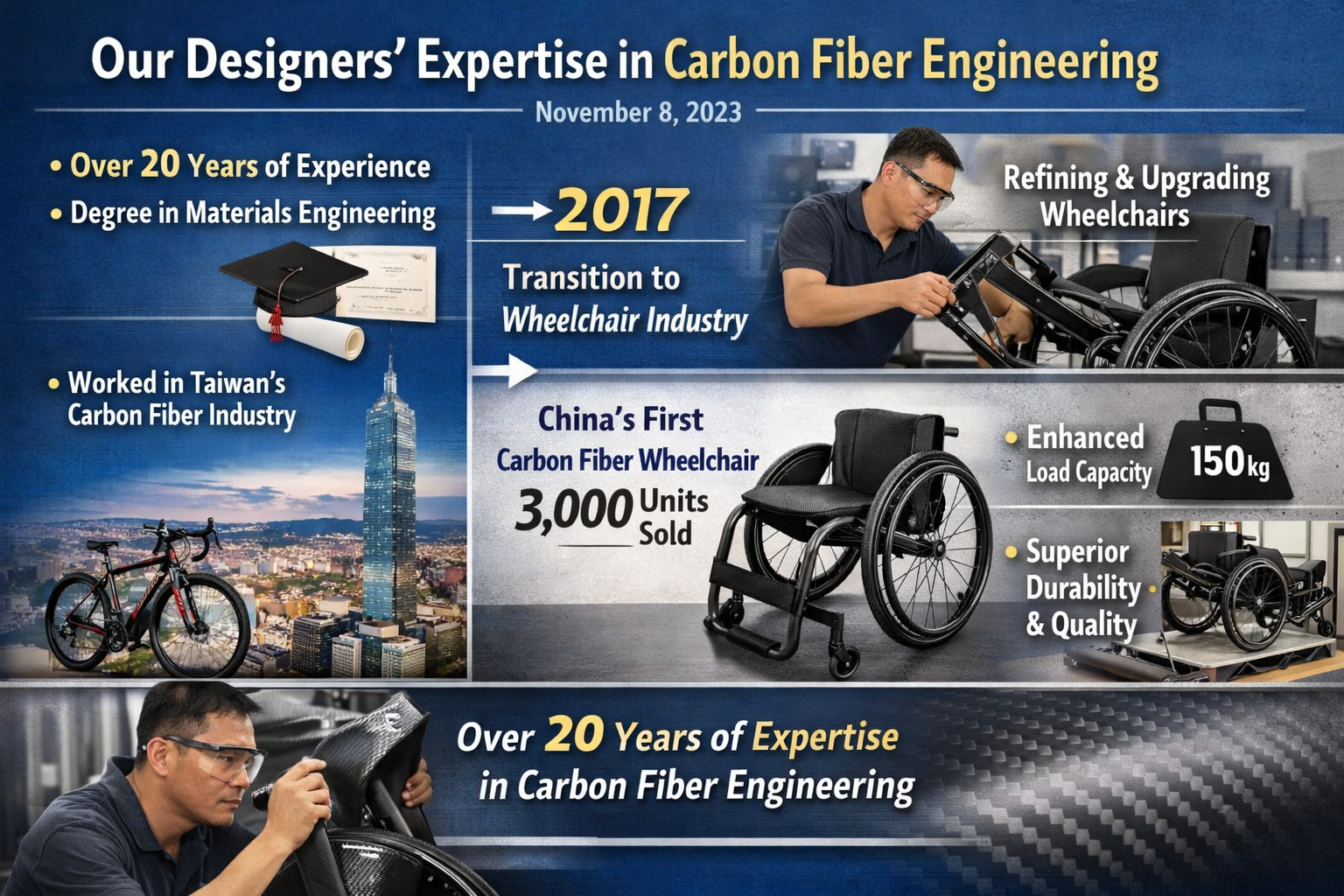
The journey began with a rigorous foundation in materials science and engineering, which established the essential scientific lexicon: polymer chemistry, fiber-matrix interfacial bonding, anisotropic material properties, and fracture mechanics. This academic grounding provided the critical framework for asking the right questions. However, true enlightenment occurred on the factory floors of Taiwan in the late 1990s and early 2000s—a period when the region was ascending as a global epicenter for advanced composite manufacturing.
Here, theoretical knowledge collided with gritty reality. Our designer immersed themselves in the hands-on, often temperamental art of transforming raw prepreg into finished structures. This was an apprenticeship in the material's very soul. They learned to discern the subtle differences in the "drape" of a 3K twill weave versus a unidirectional tape, feeling how each conformed to complex curves. They developed an intimate understanding of resin kinetics—how viscosity changed with temperature, how gel time dictated workability, and how the exothermic reaction during cure needed to be managed to prevent overheating. They became a forensic expert in defects: diagnosing the root cause of a void (was it from inadequate vacuum, resin starvation, or outgassing?), understanding how a barely visible wrinkle in a ply could become a stress riser leading to delamination, and learning to "read" the striations on a fractured laminate to understand the failure mode. This period cultivated a sixth sense—an ability to look at, or even listen to (through tap testing) a carbon fiber component and intuit the story of its manufacture and its inherent strengths or hidden flaws.
For nearly two decades, this honed expertise was tested in the relentless, performance-at-any-cost arena of high-end bicycle design and manufacturing. This industry is a merciless teacher where success is measured in grams saved and watts gained, and failure can have immediate physical consequences. It was a graduate school in extreme engineering discipline.
Our designer led R&D teams tasked with a near-impossible paradox: create structures of breathtaking lightness that could withstand monstrous, repetitive loads. A mountain bike frame must absorb the shock of a six-foot drop while remaining stiff for pedaling efficiency. A road bike fork must be aerodynamically sleek yet resist the torsional forces of hard cornering and braking. In this environment, our designer mastered the complete innovation lifecycle:
Advanced Simulation & Prototyping: Utilizing and later pushing the boundaries of Finite Element Analysis (FEA) software to model not just static loads, but complex multi-axis fatigue cycles and impact dynamics.
The Brutality of Testing: Overseeing and interpreting data from punishing test rigs—bashing frames millions of times on hydraulic actuators, subjecting them to extreme overloads until they screamed and failed. Each failure was not a setback but a data point, a revelation informing the next iteration.
The Pursuit of Manufacturing Perfection: Developing and refining proprietary lay-up schedules and autoclave cure cycles to achieve optimal consolidation and repeatability, batch after batch.
A defining chapter was providing OEM (Original Equipment Manufacturing) and ODM (Original Design Manufacturing) services for iconic, innovation-driven brands like Specialized. This experience was transformative. It instilled a world-class, brand-agnostic standard for quality. It meant adhering to safety protocols and lifecycle testing regimes that far exceeded industry norms. Most importantly, it ingrained a philosophy where the rider's experience—the feedback through the handlebars, the compliance over rough roads, the feeling of direct power transfer—was the ultimate design criterion. Performance was never an abstract metric; it was a somatic, lived experience.
In 2017, a pivotal realization catalyzed a deliberate and profound career shift. Our designer recognized that the sophisticated engineering principles, material mastery, and user-centric philosophy honed in the pursuit of sporting glory could be directed toward a challenge with even deeper human significance: transforming personal mobility. The carbon fiber wheelchair industry at the time, while promising, often lacked the ruthless performance optimization and sophisticated engineering culture of elite cycling.
This transition was an act of translational genius. The expertise was not simply transferred; it was thoughtfully adapted. Our designer played an instrumental role in the development and engineering of what became China's first commercially successful, mass-produced carbon fiber wheelchair. This project was a masterclass in re-contextualizing engineering wisdom. The aggressive, forward-leaning geometry of a race bike was recalibrated into a configuration that prioritized stability, efficient center-of-gravity management, and secure seated posture. The understanding of lateral stiffness for cornering was translated into designing a frame that resisted torsional flex during one-handed maneuvers or diagonal loading, ensuring precise tracking. The obsession with efficient power transfer from legs to pedals was reimagined as optimizing the kinematic relationship between the user's upper body, the handrim, and the drive axle of the wheelchair for propulsion efficiency.
The resounding market success of this product, with sales exceeding a thousand units, was a powerful validation. It proved there was a passionate user base that recognized and valued the application of true high-performance engineering to mobility aids.
Today, this unparalleled depth of experience is not a historical footnote; it is the dynamic engine of our company's R&D and the bedrock of our quality ethos. Our designer’s influence is omnipresent, tangible in every major breakthrough:
1. Hyper-Optimized Structural Architecture: Moving far beyond simple tube replacement, our designer employs a holistic, systems-engineering approach. Using FEA techniques refined in cycling, they orchestrate complex "ply books" where each layer of carbon is strategically placed and oriented. High-modulus fibers are deployed like reinforcement in a concrete pillar, placed precisely along primary load paths (e.g., around axle junctions, under the seat rail). In contrast, areas requiring controlled flex or vibration damping may use different weaves or resin systems. This results in frames that are not just strong, but intelligently strong, achieving exceptional safety margins and load-bearing capacities (routinely exceeding 125kg) while shaving every superfluous gram.
2. Aerospace-Grade Quality and Reliability Systems: Drawing from the culture of zero-defect expectations in premium cycling, our designer has architected a quality assurance regime that is forensic in its rigor. This includes:
3. Material Provenance and Batch Control: Every roll of prepreg is logged and tested for resin content and cure profile.
• Non-Destructive Evaluation (NDE): Implementing ultrasonic C-scan testing for critical structural components to create a 3D map of internal integrity, detecting voids or delaminations invisible to the eye.
• Accelerated Life Testing: Custom-designed multi-axis fatigue rigs that simulate a decade of daily use—including curb drops, asymmetrical loading, and repetitive propulsion forces—in a matter of weeks, providing empirical data on long-term durability far surpassing standard static testing.
4. Biomechanically Intelligent, Human-Centric Design: This is where the cyclist's empathy for the human-machine interface shines brightest. The expertise manifests in nuanced ways:
5. Ergonomic Geometry: The frame's geometry is tuned for optimal posture and propulsion biomechanics, affecting the seat-to-back angle, the front frame angle (dump), and the overall wheelbase to balance stability with agility.
6. Contact Point Optimization: The design of ergonomic handrims, the contour and padding of the seat, and the placement of push handles all reflect a deep understanding of pressure distribution, grip biomechanics, and caregiver interaction.
7. Ride Quality Engineering: The composite structure is tuned not just for strength, but for a specific "ride feel"—a degree of vertical compliance that dampens high-frequency vibrations from rough surfaces, reducing user fatigue, while maintaining lateral stiffness for responsive handling.
8. Leadership and Cultural Catalyst: Beyond technical output, this expertise fosters a culture of excellence. It mentors a new generation of engineers, teaching them to respect the material's complexity. It encourages a mindset where "good enough" is never accepted, and where every design decision is challenged against the twin pillars of performance and human benefit.
The value of this decades-spanning expertise is immeasurable and forms the core of our brand's promise. It is the guiding compass that ensures every decision—from the molecular selection of a resin hardener to the final torque setting on a caster fork—is informed by a vast reservoir of success, failure, and profound understanding. It transforms our wheelchairs from products that are passively "made of carbon fiber" into dynamic systems that are actively and masterfully engineered from it.
For our users, this legacy translates into a profound and warranted trust. They can be assured that their mobility device is born from the same philosophical and technical crucible as the equipment used to win Tour de France stages or Olympic medals. It is expertise that does more than build products; it builds confidence. It translates into a wheelchair that feels responsive, secure, and efficient—a tool that doesn't just facilitate movement, but enhances it, empowering lives with a silent, robust, and deeply engineered dignity. This is the ultimate return on a lifetime of expertise: not just a superior product, but a tangible elevation of human freedom and potential.
 EN
EN