
The genesis of a premium carbon fiber wheelchair is not merely an assembly of parts; it is an epic saga of transformation, a meticulous alchemy that turns ethereal, silken filaments into a structure of paradoxical grandeur—simultaneously ethereal in weight and formidable in strength. This journey stands as a stark antithesis to the subtractive, welded world of tubular aluminum or titanium. It is an additive, layered, and digitally sovereign process where complexity is not an obstacle, but the very pathway to achieving the transcendent benchmarks of performance: a sublime strength-to-weight ratio, dynamic responsiveness, and enduring resilience. The creation of each chair is a multi-stage symphony, demanding a fusion of computational prophecy, thermodynamic mastery, and artisanal dexterity, where every gram is contested and every fiber is purposefully enlisted.
Long before a single strand of carbon is touched, the wheelchair is born and perfected in a digital universe. This phase is one of rigorous simulation and optimization, replacing traditional trial-and-error with computational foresight.
1. Computational Sculpting & Finite Element Analysis (FEA): Using advanced Computer-Aided Design (CAD) software, engineers craft the initial geometry. This digital model is then subjected to the virtual crucible of Finite Element Analysis (FEA). The software deconstructs the model into millions of tiny elements (a "mesh") and simulates an exhaustive battery of real-world stresses: static loads representing a user's weight, dynamic impact forces from curb drops, complex torsional flexing during one-handed maneuvers, and millions of fatigue cycles mimicking years of use. The software identifies stress concentrations—areas of potential weakness—and strain distributions. Engineers then iteratively sculpt the digital form, adding material where needed and, more crucially, removing it where it is superfluous. This results in organic, sinewy, and often minimalist shapes that appear almost skeletal but are, in fact, perfectly optimized. Material exists only where force demands it, creating a topological map of efficiency.
2. The Birth of the Mold: Once the virtual model has passed all simulations, the design for its physical vessel begins. Each unique component—be it the main frame, a fork, a side guard, or a custom spoke protector—requires its own dedicated, precision-machined mold. Typically crafted from high-grade, temperature-stable aluminum or advanced composite materials, these molds are milled with tolerances measured in microns. They are the negative-space womb, their cavity the exact inverse of the final part. The quality of the finished component is irrevocably tied to the perfection of its mold.
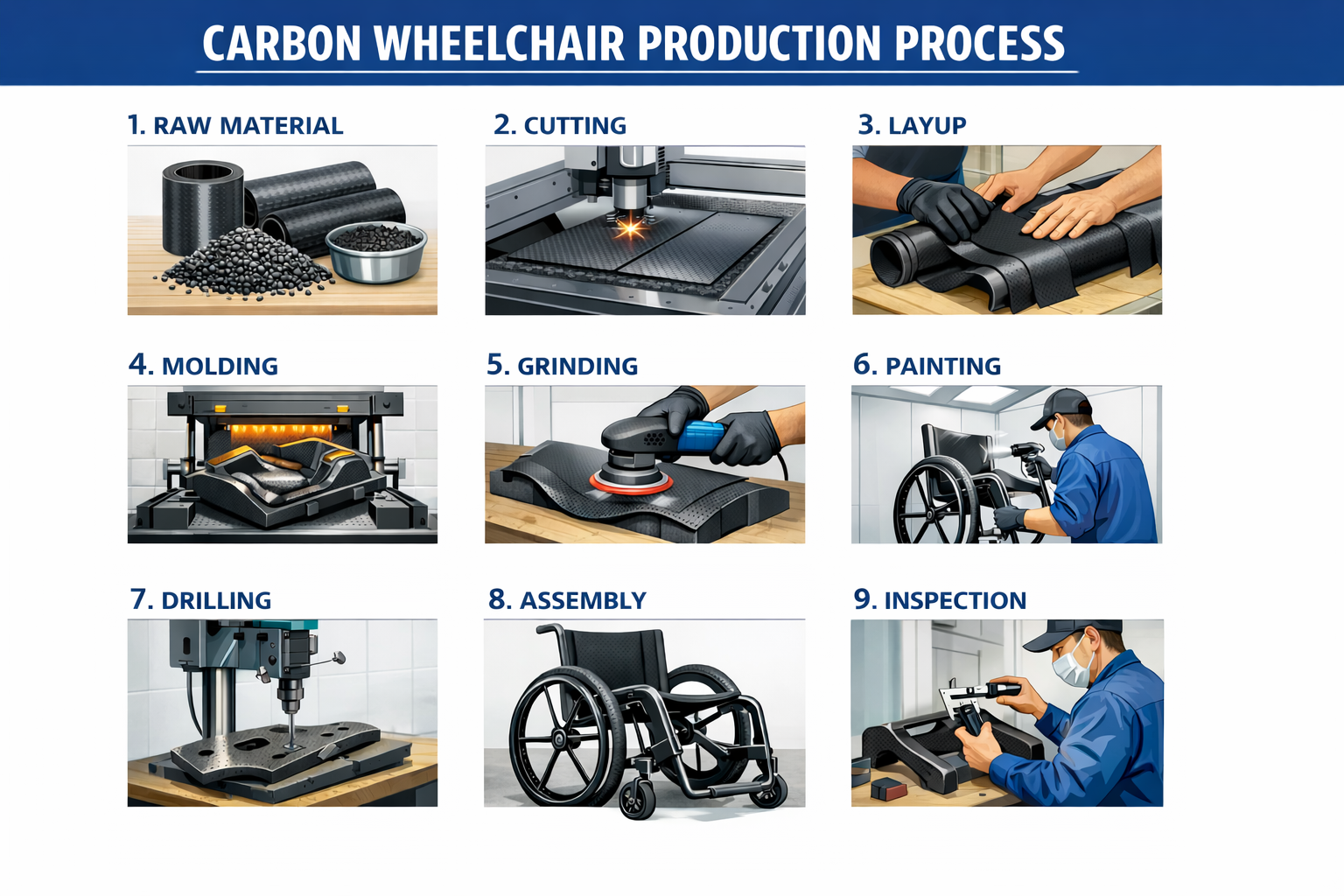
The raw material is as sophisticated as the process. Carbon fiber begins as a precursor, often polyacrylonitrile (PAN) fiber, which is through a series of high-temperature treatments (carbonization and graphitization) transformed into pure carbon crystals aligned along the fiber's axis. These fibers, thinner than a human hair, are bundled into "tows" and woven into fabrics or arranged into unidirectional tapes.
For our manufacturing, we primarily use "prepreg" (pre-impregnated) material. Here, the carbon fiber fabric or tape is already saturated with a precise amount of partially cured (B-staged) epoxy resin by the material supplier. This ensures a perfect, controlled fiber-to-resin ratio (typically around 60:40 by volume), which is critical for maximizing strength and minimizing weight. The prepreg arrives on rolls, kept frozen to arrest the curing process, and must be thawed under strict protocols before use.
Stage 1: Digital Cutting and Ply Kit Preparation
In a clean room environment, rolls of prepreg are loaded into automated cutting machines. Guided by digital ply patterns generated directly from the CAD model, computer-numerical-controlled (CNC) ultrasonic knives or lasers slice the material with razor-sharp precision. Each piece, or "ply," is cut to a unique shape and with a specific fiber orientation (0°, 90°, ±45°). These orientations are strategic: 0° plies handle longitudinal loads, 90° plies handle transverse loads, and ±45° plies excel at managing shear and torsional forces. All plies for a single part are gathered into a "kit," a two-dimensional puzzle that will become a three-dimensional marvel.
Stage 2: The Lay-Up - An Artisanal Precision
This is the heart of the craft, where human skill and patience are irreplaceable. Highly trained laminators, following detailed ply schedules, hand-place each layer into the mold. For a complex frame, this might involve carefully wrapping plies around a solid or inflatable silicone mandrel placed inside a two-part clam-shell mold. The process is meditative and exacting. Each ply must be positioned with millimeter accuracy, smoothed meticulously to eliminate air pockets (a process called "debulking" often done with rollers and vacuum between critical layers), and precisely aligned so its fibers follow the engineered load paths. A single wrinkle, bridge, or misaligned ply can act as a failure initiator. The lay-up room is a climatically controlled sanctuary, as temperature and humidity directly affect the resin’s tack and the material’s drape.
Stage 3: Curing - The Alchemical Transformation
Once the lay-up is complete, the mold is sealed and prepared for its metamorphic journey. It is placed into an autoclave—a massive, cylindrical industrial pressure oven. The cure cycle is a closely guarded recipe, a precisely orchestrated symphony of heat and pressure unique to each part's geometry and resin system. A typical cycle involves:
Vacuum Application: A vacuum bag is sealed over the mold, removing entrapped air and compacting the plies.
Pressure & Heat Ramp: The autoclave pressurizes with inert gas (like nitrogen) to high levels (5-10 atmospheres or more). Simultaneously, temperature is raised according to a specific ramp rate.
Dwell & Polymerization: At peak temperature, the resin first liquefies (becoming less viscous), flowing to fully impregnate every fiber bundle and allowing any remaining volatiles to escape. It then begins to cross-link, polymerizing from a viscous liquid into a rigid, insoluble, and infusible solid matrix.
Cooldown under Pressure: The part is cooled while still under full pressure to prevent warping or the formation of internal stresses.
This high-pressure environment is non-negotiable. It ensures an optimal fiber-to-resin ratio, eliminates microscopic voids (porosity), and creates a dense, homogenous laminate where the fibers and matrix work in perfect unison.
Stage 4: Post-Processing - The Revelation of Form
After curing and cooling, the part is "demolded"—revealed in its "near-net shape." It now bears the exact geometrical imprint of the mold but with excess material (flash) at the edges. It proceeds to CNC trimming stations. Here, robotic arms equipped with diamond-tipped routing bits or water jets perform surgical milling, trimming away the flash and cutting out precise holes for axle mounts, caster stems, and bolt interfaces with tolerances as tight as a few hundredths of a millimeter. This step transforms the part from a molded blank into a functional component ready for integration.
Stage 5: Integrated Finishing & Quality Assurance
The component then enters the finishing stage, where our proprietary matte surface treatment is integrated, as detailed in our companion article. Before moving forward, each part undergoes rigorous inspection. This may involve ultrasonic testing to detect hidden voids or delaminations, dimensional checks with coordinate measuring machines (CMM), and visual examination under calibrated lighting. Only parts that pass this gauntlet proceed.
Stage 6: Assembly - The Final Harmony
Carbon fiber components are not welded; joining is achieved through a combination of high-strength, aerospace-grade structural adhesives and precision titanium or aluminum alloy hardware. Adhesive bonding spreads loads over a wide area, creating incredibly strong and fatigue-resistant joints. Hardware provides mechanical redundancy, serviceability, and allows for fine adjustments.
Assembly occurs on laser-aligned jigs that hold the entire frame geometry in perfect, three-dimensional harmony. Each joint is carefully prepared, adhesively bonded, and mechanically fastened. Every wheel bearing is pre-loaded to a specific value, every bolt torqued to an exact specification with a calibrated wrench. This ensures the finished wheelchair exhibits flawless tracking (the chair rolls perfectly straight without pull), butter-smooth rotation in every moving part, and silent, creak-free operation—the hallmark of a perfectly integrated system.
This profound, intricate process is the sole reason our components achieve their staggering metrics: main frames weighing between 1.5 and 3 kilograms, side guards and footrests as light as 80 grams, yet boasting load capacities exceeding 125 kilograms. Every gram saved is a gram the user does not have to accelerate, decelerate, or lift, translating directly to reduced fatigue and increased freedom.
The complexity ensures that the wheelchair behaves as a unified, responsive organism. Energy from a push stroke is translated into forward motion with minimal parasitic loss to frame flex. Road vibrations and shock from uneven terrain are dampened and dispersed by the composite's innate viscoelastic properties, offering a smoother ride that protects the user's body from repetitive stress. The user experiences not just mobility, but a direct, connected, and exhilarating sense of control—a dialogue between human intention and engineered response.
Ultimately, this exhaustive manufacturing odyssey is a testament to a foundational refusal to compromise. It is a commitment to building not from commodity parts, but from perfected, weight-optimized structural elements, born from digital prophecy and forged in thermodynamic crucibles. Each wheelchair that emerges is therefore far more than a mere mobility aid. It is a masterpiece of applied materials science, a tool that empowers through its resilient spirit, liberates through its gravitational defiance, and endures as a legacy to the profound, beautiful complexity of its own creation.
 EN
EN